SHARING PERSPECTIVES ON IT GOVERNANCE AND STRATEGY
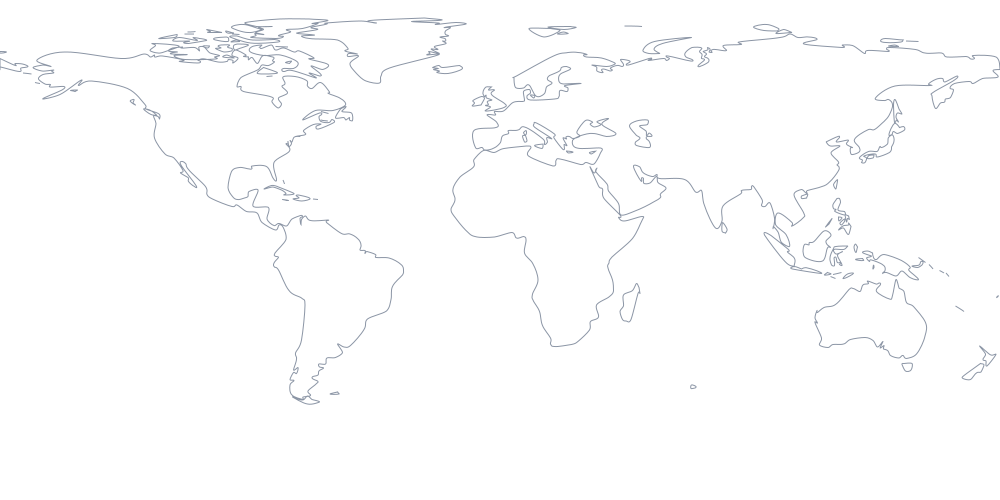
REACH: 9 COUNTRIES · 3 CONTINENTS
BASE: CASTELLÓN / VALENCIA, SPAIN · HYBRID AND REMOTE ENVIRONMENTS
IT Leader · IT governance and transformation · M&A · Information Security
I bring order to complexity. I drive progress.
Head of IT Spain — Hidrobox by TECE (TECE SE Group, Germany)
More than 10 years developing, implementing and leading technology projects in industrial and international environments. Today I lead the IT function of the Spanish subsidiary of a German industrial group, with responsibility for governance, transformation, information security, budget and corporate alignment. My previous experience in ERP projects and M&A operations allows me to combine that broader perspective with a strong technical and operational foundation.
I was born in Benicarló, home to the best artichokes in the world (or so those of us who have tasted them like to say). My career has taken me to work on technology projects in nine countries, including Spain.
10+
Years in technology projects
9
International reach (countries)
7
M&A operations on the IT side
01
Professional profile
Governance · Delivery · Judgement
I lead the IT function at Hidrobox by TECE, the Spanish subsidiary of a German industrial group, during its post-acquisition integration. My responsibilities cover governance, infrastructure, ERP evolution, Microsoft 365, information security, budget and coordination with group headquarters and specialist partners.
I turn business needs and technology risks into priorities, roadmaps and investment decisions that management can evaluate. I stay involved from assessment and decision-making through to implementation and operational adoption, keeping the broader perspective connected to day-to-day reality.
Before taking on this responsibility, I led three post-acquisition ERP implementations from start to finish and, as IT Project Manager and member of the corporate PMO reporting to the CIO, coordinated IT projects linked to M&A operations and SAP initiatives at group level. That experience meant working regularly across management, business teams, users, technical teams and suppliers, connecting those perspectives without losing sight of operational reality.
Specialisation
IT governance and transformation · Technology in M&A
Current responsibility
Leadership of the IT function · Alignment with the group
Security and compliance
NIS2 · GDPR · NIST CSF 2.0
Team structure
Internal team + specialist partners
Languages
Spanish, Catalan and Valencian · Native · English · Professional working proficiency
Working environments
On-site · Hybrid · Remote · International teams
02
Career
Each stage, and why it mattered
I left Benicarló to study Computer Engineering at the Universitat Politècnica de València and to find out how I would manage away from home. A change in the degree programme halfway through my studies made the journey longer and forced me to adapt along the way. That experience taught me to take responsibility and keep moving when circumstances change, something I have encountered many times since in industrial environments, international projects and M&A operations.
2010 — 2015Building the foundations
Web DeveloperEquipo GlobalComunica, Valencia
March–May 2014
Frontend development with HTML, CSS and JavaScript; backend development with PHP and MySQL; CMS customisation using WordPress and Drupal.
Bachelor’s Degree in Computer EngineeringUniversitat Politècnica de València (UPV), Valencia
2010–2015
I started a Technical Engineering degree in Computer Systems and, following the transition to the Bologna Process, continued my studies in the new Bachelor’s Degree in Computer Engineering.
Programming and optimisation of industrial robotics solutions following global manufacturer standards, together with the development of .NET tools and process simulations to reduce implementation times and improve operational efficiency on the shop floor. Projects in Spain (Ford Almussafes, SEAT Martorell), Romania (Ford Craiova, where I lived for nine months) and Mexico (Volkswagen, where I lived for six months).
Materials AnalystFord Motor Company, Almussafes
September–December 2015
Optimisation of logistics and the automated storage system, coordination with suppliers and training for operators.
Electrical EngineerFord Motor Company, Almussafes
March–August 2015
I analysed electronic repair data in eCATS to identify failure patterns and support operational decisions. I also developed .NET tools for maintenance and worked with different teams to turn those findings into practical improvements.
2018 — 2025Food and agriculture sector
IT Project ManagerCitri&Co, Almassora
December 2020–September 2025
As IT Project Manager and member of the corporate PMO, reporting to the group CIO, I coordinated IT projects linked to M&A operations and SAP initiatives at group level. I led the ERP implementations for Sunpack (Marrakech, Morocco), Frutas Esther (Abarán and Cartaya) and ArcoFruits (El Raal) from start to finish and on site, covering AS-IS analysis, functional requirements, testing, go-live and key-user training in English. I was also part of the IT PMO team responsible for the multisite carve-out that led to SAFRESCO, covering Peru, Argentina, Uruguay and South Africa. At Agrícola Famosa (Brazil), I coordinated an integration project on SAP S/4HANA. In both cases, I worked as the link between business teams, suppliers and the technical team. I also defined the corporate Information Security Master Plan, using NIS2, GDPR and NIST CSF 2.0 as key references.
ERP DeveloperCitri&Co, Almassora
January 2018–December 2020
I developed and enhanced Martinavarro’s in-house corporate ERP based on PowerBuilder and SQL Server, and defined the requirements needed to adapt it to the processes of RioTinto and Perales&Ferrer. I also developed automations and integrations to reduce manual work and led two group-wide projects from start to finish: the digitalisation of dispatch signatures and the standardisation of GS1 labelling, from functional analysis and supplier selection through to ERP integration.
Master’s Degree in IT ManagementUniversidad Internacional de La Rioja (UNIR), online · With additional training in cybersecurity auditing
2022–2024
It helped me strengthen my knowledge of strategic planning, risk management and the alignment of technology with business objectives, supporting my progression from project delivery towards broader IT management responsibilities.
Master’s Degree in Innovation and Digital TransformationUniversitat Oberta de Catalunya (UOC), online
2020–2022
It helped me broaden my perspective beyond technical delivery and better understand how technology can support changes in processes, organisations and ways of working.
2025 — PresentHidrobox by TECE
Head of IT SpainHidrobox by TECE, Castellón · TECE SE Group, Germany
September 2025–Present
Leadership of the Spanish subsidiary’s IT function following its acquisition by TECE: governance, infrastructure, ERP evolution, Microsoft 365, information security and budget management. I act as the link between local operational reality and the group’s technology strategy, working to increase the maturity of the IT function and strengthen its alignment with corporate standards.
Professional timeline — select a stage to explore it
——
03
International footprint
Technology projects across 9 countries, including Spain
04
Results
Measurable impact, not promises
✓
Technology assessment and IT roadmap (Hidrobox by TECE)
When I joined, I carried out a technology assessment to understand the starting point and turn it into priorities and a roadmap for the evolution of the IT function, aligned with both local needs and the wider group.
3
ERP implementations led from start to finish and on site (Citri&Co)
Sunpack, Frutas Esther and ArcoFruits: AS-IS analysis, functional analysis, fit-gap, adjustments, testing, training and go-live with users. These were the three ERP implementations linked to M&A operations that I led from start to finish; across four other operations, my involvement focused on specific phases.
7
Countries within my direct scope as IT Project Manager (Citri&Co)
I coordinated ERP implementations and IT projects linked to M&A operations and SAP, and took part as a member of the IT PMO in a four-country multisite carve-out. Across these projects, I worked directly across seven countries on three continents, connecting business teams, internal teams and suppliers.
18
IT professionals whose involvement I coordinated across projects (Citri&Co)
As IT Project Manager and member of the corporate PMO, I coordinated the involvement of the required profiles within an 18-person IT team, depending on the needs of each project. That coordination also included key users, suppliers and business teams to align dependencies, scope, timelines and cost.
€10,000+
Savings per campaign from an end-to-end project (Citri&Co)
I analysed the group’s labelling model and deployed a common GS1 labelling solution for products and logistic units, integrated with the ERP. The standardisation reduced manual work, streamlined operations and generated more than €10,000 in savings per campaign.
75,000+
Documents managed digitally per campaign (Citri&Co)
I identified an opportunity to improve a paper-intensive process and proposed its digitalisation. Once the initiative was approved, I led the functional analysis, supplier selection and ERP integration from start to finish. The new process enabled more than 75,000 documents per campaign to be managed digitally and replaced the associated physical filing.
05
How I think
Judgement, not biography
No project moves forward without the people who support it
A well-designed system that nobody has validated on the ground can fail just as easily as a poorly designed one. Before implementing anything, I listen to the people who will use it every day, because many of the decisions that shape adoption become clear there.
Governance before technology
When I structure an IT roadmap, I start with needs, risks, priorities and costs that management can compare and make decisions on. Technology is part of the answer; the aim is to make clear what each initiative solves and why it deserves attention.
Leadership also means bringing in the right expertise
Leadership means recognising what knowledge is missing and bringing it in at the right time. Whether that expertise sits within the internal team, the wider group or a specialist partner, finding the right person often makes the difference between a blocked issue and a sound decision.
Building in imperfect conditions
Legacy systems, different processes, limited resources and deadlines set before the project even begins: few transformations start in ideal conditions. My role is to prioritise, build a solid and scalable foundation, and keep moving forward with what is available while improving the conditions around the work.
Autonomy with context and support
I delegate objectives and context, not just tasks. I stay close enough to remove blockers and help people develop their own judgement, without falling into micromanagement. The best outcome is when someone can make a decision and move forward without always waiting for my answer.
Translating technical complexity into business decisions
When I present an initiative to management, I try to reduce the complexity to the questions that really matter: what each option enables, what it costs, what risk the organisation is taking and what decision needs to be made. Experience with business cases, RFPs and steering committees has taught me how to structure those conversations clearly.
Working well across distance takes discipline
Coordinating projects across countries and time zones taught me that clarity, rhythm and trust matter more than control. My role was to help business teams, internal teams and suppliers move forward together. Getting to know other cultures was also one of the parts I enjoyed most.
The foundations are common, the judgement lies in what is local
As IT Project Manager and member of the corporate PMO, I took part in a forum with CIOs and IT leaders from companies across different industries. Sharing experiences with very different organisations reinforced an idea I later applied in integration projects: many processes share a common foundation, but not everything should be standardised. Good judgement lies in deciding what belongs in a common model and what needs to remain local.
06
Technology in M&A operations
SeparateIntegrateStabiliseAlign
My M&A experience combines different but complementary responsibilities. I have led three post-acquisition ERP implementations from start to finish, was part of the IT PMO team that took responsibility for a multisite carve-out, and today I lead the IT function of a subsidiary undergoing post-acquisition integration with its acquiring group.
Select a card to see the approach
Separate before integrating: carve-out and TSA
Approach
As part of the IT PMO team responsible for a multisite carve-out that led to SAFRESCO, I contributed to the separation and stabilisation of the systems within the TSA framework and to the subsequent transition towards the group’s processes. A carve-out first requires an orderly separation; integration comes later.
Legacy systems without documentation
Approach
The real starting point rarely matches the available documentation. I start with processes, users and data, then build the AS-IS view and the fit-gap analysis. Before deciding what to replace, I need to understand what the system does and why.
Data quality before any integration
Approach
Reporting, automation and forecasting fail when they are built on data without structure, quality or clear ownership. I learnt this as an ERP developer: when data is not properly governed, the problems eventually surface in almost everything built on top of it.
Deadlines set before joining the project
Approach
When the deadline is already fixed, I separate what is essential from what is desirable, make the risks visible and agree on verifiable milestones. What matters to me is that everyone understands what is included, what is deferred and what risk we are accepting.
Standardising across subsidiaries in different countries
Approach
Order-to-cash, procure-to-pay and financial close share a common foundation, but each country retains its own legal and operational requirements. The challenge is to distinguish a legitimate exception from a way of working that has simply remained in place out of habit.
Involving key users from the outset
Approach
I involve key users from the AS-IS and validation stages to identify exceptions, refine the design and build adoption before go-live. Their early involvement often reveals issues that would be difficult to spot from the technical analysis alone.
Coordinating an integration across countries and time zones
Approach
In international integrations, decisions often involve people working at different times and in different places. Clear ownership, documented decisions and a shared rhythm help keep the work moving when internal teams, suppliers and users have only a few overlapping hours.
Turning a post-acquisition assessment into a roadmap
Approach
After an acquisition, an assessment is only useful if it helps decide what to address first. I start from the actual state of systems, processes and risks to set priorities and build a roadmap that supports gradual progress and alignment with the wider group.
Choosing suppliers and technology with sound judgement
Approach
A sound selection starts with clear technical and functional requirements. I compare alternatives based on return, risk and operational fit, and stay involved through implementation to make sure the solution delivers what we actually needed.
Carve-outs and TSAs, post-acquisition technology integration and ERP implementations in corporate-wide projects.
ERP and systems
SAP Business One, SAP S/4HANA, in-house development, and the evolution and integration of legacy systems.
Information Security and compliance
Information security governance, risk management and experience working with frameworks and regulatory references including GDPR, NIS2 and NIST Cybersecurity Framework 2.0.
International leadership
Distributed teams, executive-level interaction with group headquarters, close engagement with users and coordination across countries and time zones.
Supplier management
RFPs, partner selection based on return, risk and operational fit, and follow-through to implementation, working with internal teams and external specialists according to the needs of each project.
08
Education
2022–24
Master’s Degree in IT Management
With additional training in cybersecurity auditing · Universidad Internacional de La Rioja (UNIR)
Completed
2020–22
Master’s Degree in Innovation and Digital Transformation